

 Posts
Posts


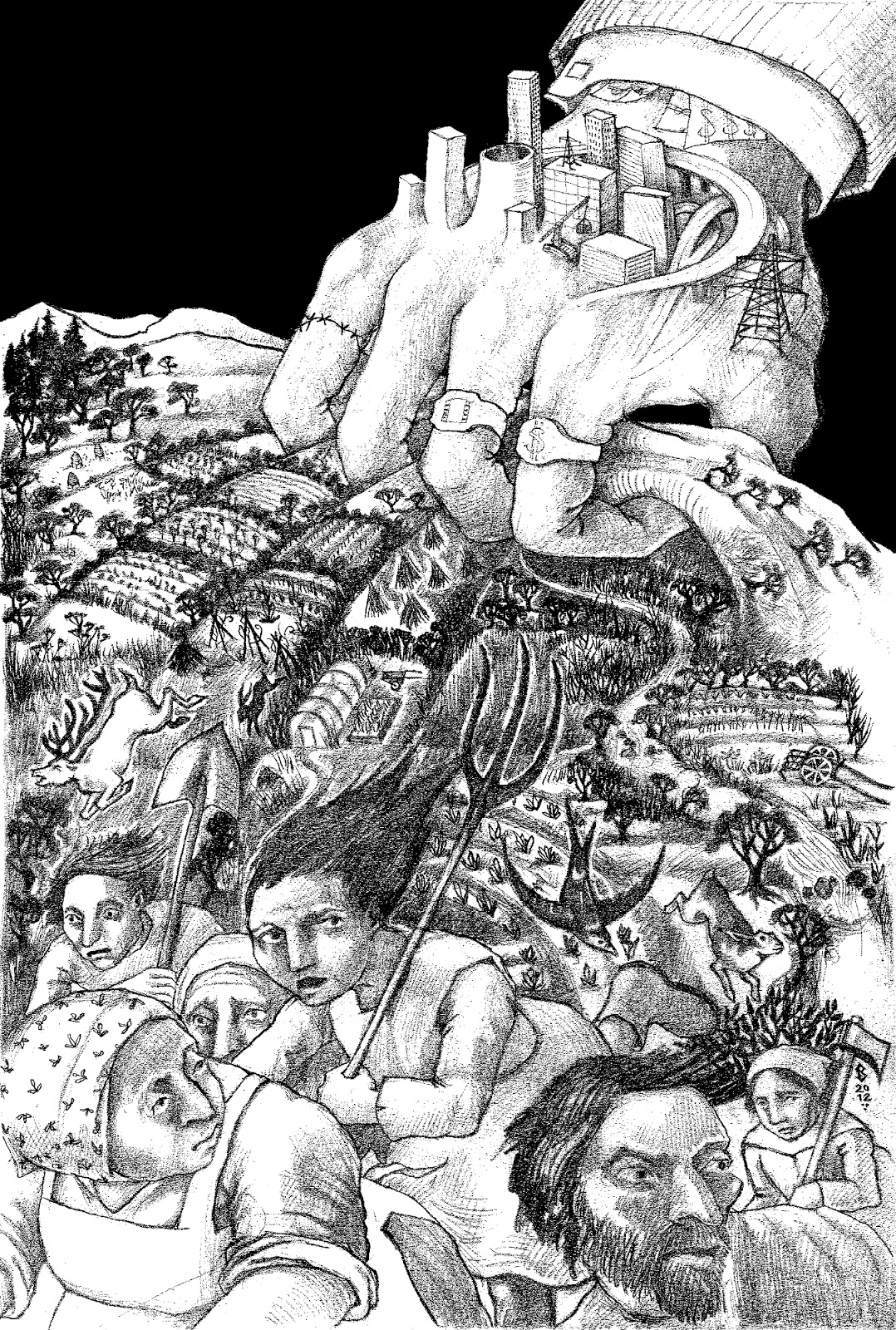
THIS DRAWING I made for the current issue of the marvellous Land Magazine ~ written by and for people who believe that the roots of justice, freedom, social security and democracy lie not so much in access to money, or to the ballot box, as in access to land and its resources
I think the drawing probably doesn't need very much explaining, but it was designed to fit in with Issue 13's theme of Land Grabs, whereby global corporations and wealthy nations buy up huge swathes of land in "less developed" countries to make money from biofuels, agribusiness, industry, and other ecocidal delights, thereby ousting those human, animal and plant communities living on that land.
Land is such a fundamental thing to all of us. It would take a certain kind of unimaginable stupidity, short-sighted greed or off-the-scale insanity to believe that destroying the land upon which you stand, your only home, is somehow sustainable. Access to land is the thing which keeps us alive, rooted, fed, watered, and sane, which is why uprooting these communities is such a terrible thing. Not so very different from what happened in this country in earlier centuries.
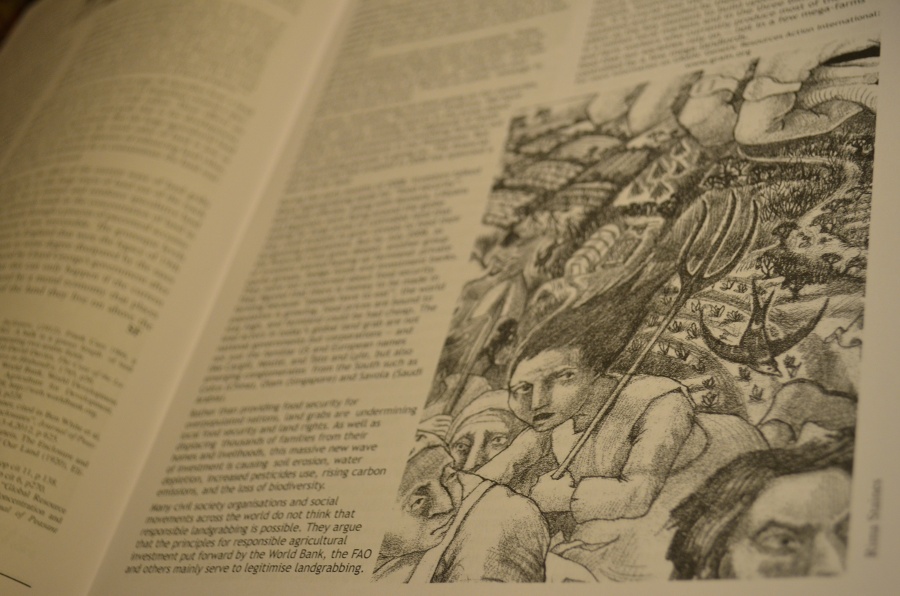 |
| My drawing in Issue 13 of The Land Magazine - somewhat cropped, for some reason |
As The Land's manifesto states:
Demands to “make poverty history”, and the responses from those in power, revolve around money: less debt, freer and fairer trade, more aid. Rarely will you hear someone with access to a microphone mouth the word “land”.
That is because economists define wealth and justice in terms of access to the market. Politicians echo the economists because the more dependent that people become upon the market, the more securely they can be roped into the fiscal and political hierarchy. Access to land is not simply a threat to landowning élites — it is a threat to the religion of unlimited economic growth and the power structure that depends upon it.
The market (however attractive it may appear) is built on promises: the only source of wealth is the earth. Anyone who has land has access to energy, water, nourishment, shelter, healing, wisdom, ancestors and a grave. Ivan Illich spoke of "a society of convivial tools that allows men to achieve purposes with energy fully under their control". The ultimate convivial tool, the mother of all the others, is the earth.
The timeline of civilisation has mapped a continuous robbery of land from the poor, the indigenous, the non-human, to bring us to the point where those holding the power own or control a vastly disproportionate area of land to their numbers; for example: Queen Elizabeth II, current monarch of this tiny green-grey island in the North Sea, "owns" 6,600 million acres of land, one sixth of the earth’s non ocean surface.
So, in the face of this sickenly unfair system, what choice do we have but to grab the land back? As Gill Barron points out in her excellent article on land-reclaiming - There is an honourable tradition worldwide, and strongly so in Britain, of small-scale land acquisition by stealth. These historic precedents suggest that even more of us should be actively following in the noble (if a bit scruffy) footsteps of our cotter & squatter forebears. [The Land - Issue 13]

Alongside the many admirable land-reclaimers, guerilla gardeners and squatters mentioned in Gill's article, a group of folks off the western shoulder of London's sprawl decided last year to occupy some disused land on the Runnymede Campus of Brunel University, which has lain disused since 2007 when Brunel University sold the land to a private property developer to turn into luxury homes, to much local concern. The property owner stalled, however, and so in between the apocalyptic gusts of tumble-weed blowing through the empty overgrown university buildings, watched over only by the sinister eyes of CCTV, the Diggers2012 walked in, planted vegetables, put up tents and shelters, begun building a cob longhouse, and lived. The site is significant, being so close to the Magna Carta Monument, heralded as the "birthplace of modern democracy", where the Magna Carta was signed 800 years ago, introducing, alongside democracy, ideas such as freedom through law and limitations on authority. The Diggers2012 take their name from the original seventeenth century Diggers who planted crops on St George's Hill in Surrey in order to make the land a "common treasury for all". You'll all know the folksong telling their tale:
World Turned Upside Down
written by Leon Rosselson
recorded by Dick Gaughan
In 1649
written by Leon Rosselson
recorded by Dick Gaughan
In 1649
To St George's Hill
A ragged band they called the Diggers
Came to show the people' s will
They defied the landlords
They defied the laws
They were the dispossessed
Reclaiming what was theirs
We come in peace, they said
To dig and sow
We come to work the land in common
And to make the waste land grow
This earth divided
We will make whole
So it can be
A common treasury for all.
The sin of property
We do disdain
No one has any right to buy and sell
The earth for private gain
By theft and murder
They took the land
Now everywhere the walls
Rise up at their command.
They make the laws
To chain us well
The clergy dazzle us with heaven
Or they damn us into hell
We will not worship
The God they serve
The God of greed who feeds the rich
While poor men starve
We work, we eat together
We need no swords
We will not bow to masters
Or pay rent to the lords
We are free men
Though we are poor
You Diggers all stand up for glory
Stand up now
From the men of property
The orders came
They sent the hired men and troopers
To wipe out the Diggers' claim
Tear down their cottages
Destroy their corn
They were dispersed -
Only the vision lingers on
You poor take courage
You rich take care
The earth was made a common treasury
For everyone to share
All things in common
All people one
We come in peace
The order came to cut them down
I visited the Diggers2012 camp last autumn, following a path through the woods and a wheelbarrow track through the dewy grass to a hole in the chicken wire fence.


And found there a friendly and diverse group of people sat around a fire in the main cob longhouse, talking unhurriedly about the day's plans, and cooking breakfast.


There were escapees from London, who had found no way to live the expensive life the city demands, nor been able to afford housing. There were activists and foragers and visiting families with children and dogs. Fifteen people were living there permanently, and as we sat and drank our fire-cooked coffee, they referred, with despairing seriousness, to the sprawling city which we could see in the distance from our hill as Mordor.


As well as growing vegetables and running workshops, they had set up a rudimentary water system from a spring higher up in the forest, which carried the water down through a long blue pipe via a home-made filter suspended between the trees.


I felt a great deal of purpose in the people I met there. They had had several evictions served against them but were fighting on, with a great openness to engage with the local and wider community, and challenge the deeply embedded idea of land ownership. The day I was there they were leading a foraging walk, and visitors gradually arrived to join us on the hunt for wild foods and medicines growing on this patch of "disused" land.


We found various edible and useful mushrooms, this one below is Chicken of the Woods


There were escapees from London, who had found no way to live the expensive life the city demands, nor been able to afford housing. There were activists and foragers and visiting families with children and dogs. Fifteen people were living there permanently, and as we sat and drank our fire-cooked coffee, they referred, with despairing seriousness, to the sprawling city which we could see in the distance from our hill as Mordor.
As well as growing vegetables and running workshops, they had set up a rudimentary water system from a spring higher up in the forest, which carried the water down through a long blue pipe via a home-made filter suspended between the trees.
I felt a great deal of purpose in the people I met there. They had had several evictions served against them but were fighting on, with a great openness to engage with the local and wider community, and challenge the deeply embedded idea of land ownership. The day I was there they were leading a foraging walk, and visitors gradually arrived to join us on the hunt for wild foods and medicines growing on this patch of "disused" land.
We found various edible and useful mushrooms, this one below is Chicken of the Woods
Not all fungi were in easy reach
We returned to the camp to make tea, and I had to leave before getting the chance to share in the meal of foraged foods.
But I did learn a new plant - this is water pepper - which has amazing spicy-tasting seeds!
It seems to me that we have been so disconnected from the land beneath our feet by so many tools of modern civilisation, that we no longer are able to tend it and speak to it, live with it and love it and know deeply that we cannot live without it. And because we have had our earthen umbilical cords which tie us to our ancestral place cut so brutally, for so long, we cannot stand up for our land when it is threatened, either. As Derrick Jensen says: "It's no wonder we don't defend the land where we live. We don't live here. We live in television programs and movies and books and with celebrities and in heaven and by rules and laws and abstractions created by people far away and we live anywhere and everywhere except in our particular bodies on this particular land and this particular moment in these particular circumstances."
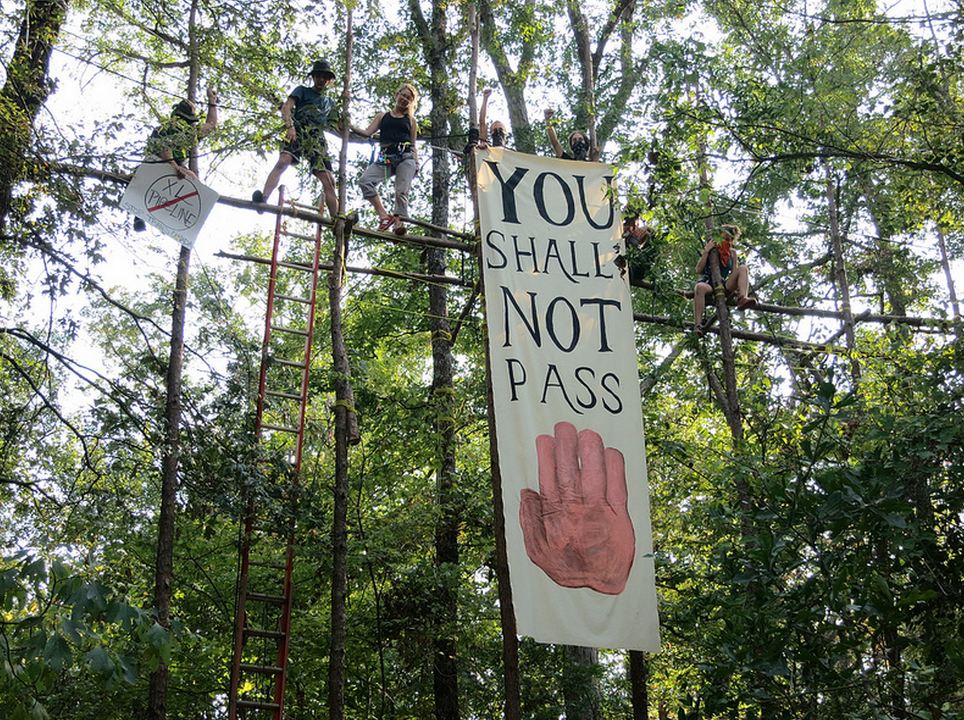 |
| Activists take to the trees to stop the Keystone XL pipeline in Texas and Oklahoma as part of the Tar Sands Blockade |
I've walked this hill a hundred times
To hear the river talking
A murmuring, a secret sound
Never found
And times I've leaned into the wind
To smell this earth I'm walking
With the song of the wind my heart is wound
All around
It's holy ground
CHORUS:
You can bring your JCBs
You can bring your drills and your 'drivers
You've got the might
But you've got no right
We'll be there, we'll be there, we'll be there
We've wandered under winter stars
To trace them in their courses
Summer nights at standing stones
We stood alone
We took the water in our hand
We rode the chalk-white horses
We dreamt one day they'd understand
We share this land
This holy ground
CHORUS
Leave this, leave this land alone
Leave this, leave this land alone
Leave this, leave this land alone
Leave this, leave this land alone
Leave this, leave this land alone
I said leave this, leave this land alone
Leave this, leave this land alone
Leave this, leave this land alone