

 Posts
Posts


 I THINK I HAVE FOUND work by another artist that is the closest thing to my own sensibilities that ever I have seen, and I'd like to show it to you ...
A few months back I was given a little local Scottish magazine by a neighbour who thought a particular article in it might be up my street. And Oh it was. I read in there of a Russian kinetic theatre of wooden sculpture hidden in the heart of Glasgow. And two days ago I went to see it.
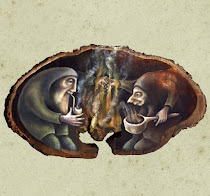
 Down a narrow alleyway and round the corner was a door, and on the door was a drawing of a behatted crow with a bell in its beak. Behind the crow were stairs, and at the top of the stairs was the most unusual wonderland I could ever have hoped to come across. A roomful of contraptions, huge automata-like machines, moved by and moving small painted woodcarvings with hooked noses. There were endless wheels, cogs and clocks, old pieces of scrap, sections of sewing machines, typewriters and lawnmowers, bicycles and bells, and delightful characters ~ melancholic, strange and grotesque in the best possible of ways.
Fat bellied mice, nuns and hunchbacks, clowns and skellingtons, monkeys with donkeyheads for hands, grinning jesters and snap-jawed monstrosities, bears, saints, artists and alchemists, monkeys with wayward willies, and organ-grinders and ravens of all sizes and sorts joined in a mechanical dance ~ macabre and humourous, sad and wise and utterly fascinating. They seemed to be telling me tales of the world turning, of lives and deaths and back again, of torture and spirituality, of the wheel and all its spokes. Lights shone on the pages of this kinetic story and took me from one character's part to the next, and all the while music played ... something from a far off circus, a dusty street musician, an echoing dungeon, a shtetl in winter.
 Sharmanka Kinetic Theatre is the work of Russian artist Eduard Bersudsky. Born an outsider in St Petersburg in 1939, he is a self confessed black sheep or "white crow" as the Slavs say, who began his work amidst the struggles of Soviet Russia and and left in 1994 to settle in Scotland and bring with him his magnificent theatre. His work has been brought tirelessly into the public eye by Tatyana Jakovskaya, theatre director and critic who he met in 1987. Sharmanka (which means organ grinder or hurdy gurdy in Russian) has its base in Glasglow at present but a touring version can be seen here and there and elsewhere, and Eduard's works have been commisssioned to stand in various town centres, museums and private collections in places as far an wide as Scotland, Jerusalem, Russia, Denmark, America.
 Eduard requests that he never see his audience nor they him, and speaks only a handful of English words. I was lucky enough however to meet him briefly and see his workshop and new piece in progress which will incorporate an old set of bellows into its heart. He is a man dedicated utterly to his work and collects like a magpie more bits and pieces of machinery to incorporate inside his creations, which have names like The Clock of Life, The Hunchback, The Tower of Babel, The Little Organ Grinder, Time of Rats, The Rag-n-Bone Man, Willy the Barrel Organ, Brainwashing Machine, The Tower of Medieval Sciences, The Leg, Eternal Triangle of Love, The Tree of Life, Druid's Clock, The Autumn Walk in the Belle Epoque of Perestroika ...
 I cannot express adequately quite how in thrall I was to these little wooden men and the wheels that turned them. Bersudsky has been described as "an icon painter for our times" and that he is. Really it is impossible to convey in words how brilliant this kinetic theatre of woodcarvings is. You simply MUST go and see it. Even if you do not live in the UK ... get a plane, a boat, a train, a bicycle, a tricycle, a donkey, a snail, a unicycle! Just come to a show! They are on thursdays and sundays. Photographs cannot evoke the magic enough, so here are a few videos, but even they are like weak imitations compared with standing close to one of the beautiful Sharmanka machines as it creaks into life. Thank you Eduard.
Now, if your senses are not overloaded, I thought I'd invite another guest to this clockish automata-party: The Chronophage.
It was recently brought to my attention that on my just gone birthday, a new and astonishing clock was unveiled in Cambridge. The invention of John Taylor, clockmaker and admirer of John Harrison, who solved the problem of longitude in the eighteenth century, is a 24-carat gold-plated clockwork clock, that keeps accurate time whilst showing that it time is relative. On top of the clock, time is measured out by the grasping legs of a demonic locust-like chronophage or time-eater.
Taylor says:
“Clocks are fixed, whereas we all know, time is fluid. It drags and it flies. Like Einstein said, an hour sitting next to a pretty girl can be like a minute, and a minute sitting on a hot stove can seem like an hour. I wanted this clock to reflect that, to play tricks with observers.”
Dr Christopher de Hamel, Fellow Librarian at Corpus Christi, says:
“I wanted it to be a monster, because time itself is a monster . . . It is horrendous, and horrible, and beautiful. It reminds me of the locusts from the Book of Revelations. It lashes its tongue, and flicks its eyes at you. It’s bonkers.”
And here it is in action ...
So I leave you with all these lovely mad tickings and ringings of bells and will return soon with my own clock ... Once Upon O'Clock number 5.