




 Posts
Posts


 THIS WELL KNOWN AND LOVED character has evolved nowadays into the sickly-sweet “acceptable” American Santa Claus, but he has ancient and diverse origins, which are not all so “clean” and indeed may not be so successful in the realm of ringing cash registers!
Father Christmas is a blend of many different cultures, customs, legends and mythological creatures. His earliest ancestors date back to a time when the earth was ruled by sky-riding gods, but much of his legend is based on the life of St Nicholas, a fourth century bishop from Patara, in what is now Turkey.
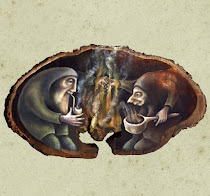
In 9th century England the Anglo-Saxons honoured King Winter or King Frost. Welcoming him as a personage or deity was believed to make the season less harsh on them. With the arrival of the Vikings to the British Isles during the 9th and 10th centuries Odin, their chief god, influenced the winter gift practices. Odin had twelve different characters and the December character was known as Yalka or Jule – this month was thus called Jultid (our Yuletide). The Vikings believed that Odin visited earth during this time on Sleipnir, his eight-legged horse. He would be disguised in a long blue hooded cloak and carrying a staff and a satchel of bread, accompanied by a raven or crow. He was said to join groups around their fire and listen to their conversations to see if they were content. He would sometimes leave the bread as a gift at poor homesteads.
This Nordic figure lent a good deal to the image of St Nicholas, a wealthy Bishop who was nevertheless legendary for his generosity and kindness to the poor. One legend tells of three young women in his parish, who Nicholas became concerned about, since their poor father was about to deliver them to a life of slavery. He came to their house late at night and tossed three bags of gold down the chimney, landing by chance in the sisters’ stockings which were hung by the hearth to dry.
St Nicholas was remembered for his championing of the needy and of children and has lent this generous spirit to our Christmas celebrations. After the Protestant Reformation of the sixteenth century, the veneration of Catholic Saints was banned and people did not want to lose their winter gift-giving saint. St Nicholas underwent a transformation into a new, non-religious but nonetheless generous figure. He became Weihnachtsmann in Germany, Father Christmas in England, Pere Noel in France and Sinter Klaas in Holland, although he is still also referred to as St Nicholas. The Scandinavians also lent their gift-giving elves like the Tomte to the image of Father Christmas, adding a friendly rotundness to his slightly austere image.
Father Christmas has various companions, one of which in Germany is Knecht Ruprecht. However, not all of his helpers are frightening; the Christkindl, meaning Christ Child, was thought to accompany him in many countries. Indeed, the Christian Christmas story is difficult to separate from these other winter legends.
Father Christmas’ connection with reindeer harks back to ancient times when the Winter King was a symbol of masculine natural energy, embodied in the stag and other horned animals. His reindeer are replacements for Odin’s eight-legged horse Sleipnir. Magic is obviously an integral part of the legend and enables Father Christmas to deliver gifts to all children around the world on Christmas Eve!
Immigrants to the New World brought along their beliefs and customs, the Dutch settlers bringing Sinter Klaas – later to become the modern American Santa Claus.
Illustration: drypoint etching
Tuesday, 1 January 2008
Father Christmas

Monday, 31 December 2007
Knecht Ruprecht
 A DARK FIGURE from Germanic folklore, Knecht Ruprecht, meaning Knight Rupert, accompanies St Nicholas when delivering gifts and represents the more frightening side of this custom. He is also known as Black Peter, so called from the soot in the chimneys he goes down.
In some places, the image of St Nicholas has merged with Knecht Ruprecht to form “Ru Klaus” meaning Rough Nicholas, so named because of his rugged appearance; “Aschen Klaus”, meaning Ash Nicholas because of the bag of ashes he carries with him; and “Pelznickle”, meaning Furry Nicholas, referring to his fur-clad appearance.
Knecht Ruprecht is there to reward good children and punish naughty ones. He sometimes carries with him a chain or birch rod to beat those who have misbehaved and an empty sack in which to carry them away! These beliefs are obviously well exploited by parents around Christmas time!
It is unclear where the Knecht Ruprecht figure has come from. Some say that St Nicholas put the devil in chains and made him his servant.
Illustration: drypoint etching