

 Posts
Posts


FROM
THE LOVELY late Maying to this humming cloudless unfamiliar summer
heat, the Earth has been laughing in flowers. I have watched the
lanes and the hills and the riverbanks as they've blossomed in a
great rush of colour – one after the other after the other – a
froth of petalled joy spilling my heart over and calling, calling in
weedy green voices: a chlorophyll chorus, this time unignoreable.

Something
has happened this year. The plants have started calling louder than
ever before.

Those
of us who have loved the plants since childhood and dreamed of a
cronehood stalking the fields with a basket, kitchen windowsill a
stained glass apothecary of sunlight falling through bottles of
herb-infused oils and tinctures – a Church of Weeds – have heard
the hedgerows calling clearer and more insistent this year than ever
before. I wonder for how many of you the seasons' turning this year
moved something in you that had perhaps learnt over the years a
handful of plant names and their uses and maybe collected many books
on plant lore and craft, but not before with this new purpose and
dedication wanted to know the whole great encyclopedia of
leaves?

The
rushing of life into summer has been my church, and the green hands
of this land have pushed up and out and taken mine, a willing but
green apprentice, and they've begun to whisper things, now audible,
that I've been hearing and yet not hearing for many many years.

The
beauty of our Dartmoor hills stirs me every day. “We live
here!” we say to each other,
incredulous. On these hot hot days, we have swum in the cold
thrilling rivers, alive with leg-kissing fish and haloed with an aura
of insects. This land feels healthy and we fall endlessly,
unquenchably in love with it.


And
the plants go on calling. I feel a need to be able to name them,
which seems at once ridiculous – how can two Latin words given by an eighteenth century Swedish man equal the complex ancient magic of a
particular plant growing in a particular place? And yet somehow the
Latin name, an international and specific way of reference, becomes
helpful: It can tell us a story about humans' relationship with this
plant (St John's Wort – Hypericum perforatum – is
named for the midsummer saint who replaced the pagan sun magic with
which this plant is associated. The hyper-ikon
was a herb placed above the icon of St John attesting to its power
over ghosts or bad spirits – also known as depression – for which
the herb is most well known these days. Yarrow – Achillea
millefolium, an excellent wound
herb, which arrests bleeding and disinfects wounds, was
used according to legend by Achilles as a field dressing for his
soldiers' wounds during the Trojan war.) The Latin name of a plant
can tell us where that plant can be found growing (- palustris
– in marshes, - arvensis
– in fields, - sylvatica
– in woodlands), or whether it
was part of the folk medicine chests of old ( - officianalis).
Valerian - Valariana officianalis
– commonly called All-heal,
has significantly in
German-speaking countries been given over 500 distinct names, and by
the Romans was given feminine names, honouring the tall upright
white-flower-crowned grace and importance of the plant.
The
common names of plants conjure stranger, more wonderful uses and
stories, tying us to our hedgewalking forebears, and reminding us
how they knew the plants ~ wolf's
bane, wet-the-bed, jump-up-and-kiss-me, fireweed, bastard
killer, woundwort, sweethearts, sneezewort, simpler's joy,
mother-die, bedstraw, heartsease, devil's plaything, gypsy's baccy,
white man's footprints...


And
so I have continued to walk the lanes and to ask the plants and to
write down what they say in my book of the hedge. This writing has
been not only in words and names but in paint too. Out of this
ongoing hedgerow-thrall came a painting – Weed Wife –
an expression of my love for the wild plants in particular, the ones
who can thrive between pavement slabs and motorway sidings, the ones
who grow strong despite bad weather and trampling, and in whose green
veins thrum aeons of medicine for our bodies and spirits which we've
strimmed and poisoned and walked past for too long.


She
began in pencil on a beautiful heavy gnarly piece of burr oak. This
one had no preparatory sketches whatsoever; all that came before this
was the thought of a woman surrounded by plants: a Weed Wife.
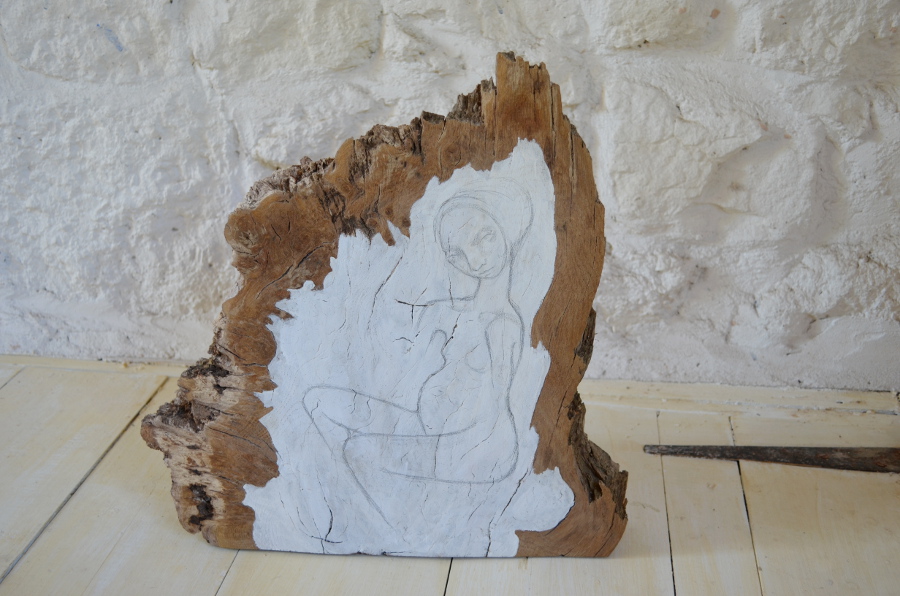
And
slowly the weeds began to grow around her.

The
wood was an awkward shape to work on – too solid and unwieldy to
rest flat on a drawing board. And so I wedged it inside an old school
desk with its lid open.

The
painting began with the Weed Wife herself.


And
then the colours crept around her in tendrils of pigment


growing
a forest of weeds.


The
detail was small and required a meticulous brush, attempting to
achieve a good likeness in every plant portrait.

Finally
(just hours before the delivery deadline for the gallery!) she was
finished:

See
if you can find all the plants in the painting...
 |
| Weed Wife - prints available here |
Hogweed,
Goosegrass, Bramble, Lady's Mantle, Hedge Woundwort, Ground Ivy,
Mallow, Dandelion, Dock, Heartsease, Nettle, Hawthorn, Herb Bennett,
Elder, Ivy, Poppy, Shepherd's Purse, Plantain, Yarrow, Mullein,
Holly.


This
painting seems to have touched some gentle yet powerful part of many
women who have seen it, bringing tears to their eyes. I can't explain
why this might be because I don't really know, though I was very
moved to hear it had this effect. Some kind of plant-song must come
out of it, revivifying a deep and long-held womanly knowing.


The
weeds continue their lessons as the year burns on, catching the light
of every day in their green blood, in their thorns and hairs and petals, throwing me
riddles and conundrums, singing me songs, and I listen as best I can,
my ear still not fluent in the nuances of the language of their
country.


I
have begun to properly collect and dry plants found around and about
where I live (all of the close up photographs of plants in this post
were taken within a few yards of my home, and the rest within a few
miles). I feel that the plants sharing soil and water with me are
bound to have better medicine in them for me than some commercially
grown and packaged herb flown in from overseas ever could, not to
mention the extra and particular magic that will be inevitably mixed
into any brew I make based on the intentions and reverence I hold
whilst picking and preparing.


I've
fashioned a very rudimentary drying rack for a tiny house out of an
old crate, some strips of muslin, bits of bamboo and gaffer tape.
This hangs over our wood burner on the clothes drying rack in between
the towels and socks. One of these days I'll make a nicer version out
of willow but this works very well for now.


And
the dried plants are going into jars, for which I have yet to make
labels...


Three
plants flowering about our home at the moment combined to chase away
a cold that threatened to drag Tom under. I brewed up Elderflowers
and Yarrow (which both have excellent exterior-releasing qualities causing an illness-eliminating sweat) and Honeysuckle (which has
wonderful antiseptic and soothing properties). A few hot brews of
this with honey chased it away good and proper, and Tom awoke the
next morning free of the cold!


Some
years ago during my Book Arts studies, I made a book of plant lore –
a Herbal Alphabet with one plant for each letter, each one illustrated
by a woodcut illustration of a story surrounding the uses and
folklore of the plant. The text tells of botany, history, folklore,
superstition and medicine, and I bound the whole thing by hand. It
was a one-off creation, my love of Herbals and the plant knowledge
therein strong even then; and I find myself coming back to it now and
referring to it, finding information in it that I'd forgotten.


It
shares shelf space with many other excellent Herbal tomes, a few of which
you can see here:


A
small selection of plant books that have caught my imagination
recently or become oft-referred-to old favourites follow:
The Energetics of Western Herbs Vol 1 & 2 – A Materia Medica
Integrating Western and Chinese Herbal Therapeutics by
Peter Holmes
The Secret Teachings of Plants – The Intelligence of the Heart in
the Direct Perception of Nature by Stephen Harrod Buhner
Traveller's Joy by Beshlie
Wild Flowers of Britain by Roger Phillips
This
last book is by a true weed wife of whom many of you will know. Juliette de Baïracli Levy spent her life travelling and living with
the peasants and nomadic peoples of many countries, learning their
medicine. She raised her children and Afghan hounds according to what
she learnt along the way. Her life was a flourishing garden of
glowing health and a deep and simple love for the Earth. I was first
captivated by her ways after being given her book Traveller's Joy
by a friend at the Weird and Wonderful Wood Fair this year, but she
has written many, which are full with remedies for both humans and
animals, that you know she has used and perfected.
This beautiful hour-and-a-bit-long film about her life will beguile you utterly, I heartily recommend taking the time to watch it:

Meanwhile
the plants go on calling, and the small beautiful creatures who know the language of plants best of all answer in their miraculous iridescent orchestra of humming and
scraping and buzzing and weaving and tasting and pollinating and
egg-laying and cocooning and Keeping It All Going...


The Weed Wife original painting is on display at the Green Hill Arts Gallery in Moretonhampstead, Devon until 7th August and prints small and large can be purchased here.

Yesterday, down our lane, we found our beloved hedgerow massacred by brutal farm hedge-cutters which had hacked the whole living ecosystem back to a stubble of chewed stems and gouged banks. I found myself profoundly affected by this - heart-sad at the loss of specific plants I had come to know and love and watch grow day by day. I mourn their destruction and am left speechless at the way supposed "stewards of the land" can come at a tiny delicate rare variety of Imperforate St John's Wort which I'd found growing there a few days before with a huge indiscriminate cutting machine. I don't suppose the farmer even knew that little flower was there.

I will go on walking the hedges, listening to the plants, learning their names, telling them how I am glad that they live and thrive and trusting always in their ability to crack concrete.


stay together
learn the flowers
go light
~ from For the Children by Gary Snyder