Showing posts with label old women. Show all posts

Wednesday, 24 November 2010

Marvels and Tales


HERE'S A MARVEL & A TALE... This autumn, in the rather marvellous Journal of Fairy Tale Studies published by Wayne State University Press, Marvels & Tales, are three drawings of mine, and a few words too.


Illustrations aren't usually published in the journal, I was told, apart from the occasional turn of the century fairy tale painting. So in a new departure for the journal, they've included my drawings in a Texts & Translations section, for fairy tale responses and interpretations.

Here published below are the three drawings of a favourite fairy tale archetype of mine - The Old Woman In The Woods - and my accompanying article. The drawings were made over a year ago in charcoal and pencil.


But I do urge you to investigate the paper version, which arrived in the post this week. It is published biannually, and is full this autumn with academic musings on giants trampling the earth, stepmothers and narrative disobedience in Pan's Labyrinth, amongst a great deal else...
Also, do tell me if you would buy prints of these drawings, and I'll rustle some up!
{EDIT : Prints for sale in the shop now! Large and small, roll up, roll up! }


________________________________

DRAWING THE OLD WOMAN IN THE WOODS


That old woman. She is sometimes frightening, sometimes kind, always ancient, always cunning, and she always dwells deep in the woods where children become lost.
She who lives in a little house in the forest is a tale-character you'll have met often. Her stories are rich and dark, and hopefully quite terrifying.

This old crone has been a long fascination of mine. My years of loving folktales have repeatedly brought me back to her. I imagine myself as her one day, if not now (though I am young still).
These three drawings are three hag-grandmothers, three ancient crones of fairytale, three faces of the same old woman. Here I have drawn her as Baba Yaga, Red Riding Hood's Grandmother, and Hansel and Gretel's Witch. These are three well recognised guises of the old lady, and my drawings are portraits of each crone with her forest dwelling, because as I see it the place where this old woman lives is a vital key to understanding what she represents.


She appears as an incarnation of the crone or winter aspect of the female deities of old. She is the carrier of wisdom, the guardian of the life and death gates, the overseer of the cold months, and the stewardess of story.
We talk nowadays of long, old, particularly northern, tales as Sagas. But in some quarters it is believed that this word saga was once the feminine of the word sage and that the written sagas of Scandinavia were originally sacred histories kept by female sagas or ‘sayers'. Thus storytelling and wisdom-keeping were entwined in one person: 'She who Speaks' ~ the Oracular Priestess. Her appearance in orally passed down fairy tales seems to stress the importance of story for gaining and nurturing wisdom.

This old lady has many many incarnations in every culture and tradition, but I would like to focus particularly upon the northern snowy countries whose folklores have always drawn me.
The wild forest is a vital aspect of the tale. The tangled thicket is to me a direct representation of wilderness, of the wild nature in us all. It is the feared unknown, the darkness, the habitation of creatures strange and terrifying and of 'otherness'. It is where we must go as lost children to face adversity and death and there find wisdom and rebirth. I wonder whether folktales that feature an old woman in a little hut in the woods are more prevalent in Nordic, Slavonic and Teutonic myth. These are the places where vast particularly conifer and birch forests grow. And on these forest floors grows something else, something powerful and sacred that will show us the way into the gingerbread house...


The Fly Agaric Mushroom (Amanita Muscaria), that little white-spotted red-cap growing deep in the forest that appears so very often in fairy tale illustrations is a mushroom long revered by northern Shamans as a gateway to the Other World. Its hallucinogenic properties could take you to realms of deep knowing, beyond the everyday. I would like to here make the connection between this striking red and white fungus and the 'little hut' in the forest that belongs to that old woman. Both are found deep on the dark woodland floor, both are alike in shape, both take you to the other world. In some tales (such as Hansel and Gretel) children are tempted to directly eat of the house. In others, the journey to find the old lady's dwelling, losing oneself in the forest along the way and facing the terrors within the 'hut' could all be symbolic of the shamanic initiation process one would go through as a result of ingesting the Fly Agaric mushroom. To enter iron-toothed Baba Yaga's skull-lined chicken-legged house, or to approach the devouring wolf inside the hut of Red Riding Hood's grandmother are perhaps to face, whilst in Fly Agaric reverie, the fact of one's own death and other dark truths of nature.

In these tales, children often become lost and unable to return home. This could symbolise the initiatory process of leaving the secure nest and stepping out into the wilderness. And once inside the hut, the tales' protagonists must face adversity of one kind or another. Either they overcome the 'witch' through cunning, or are swallowed and reborn from the belly of the wolf, or they prove themselves bold and true enough to look into the eyes of the skull-lantern.


There are many folkloric 'wood-wife' characters within northern traditions. They are usually wild, hairy or mossy forest-dwelling creatures who are glimpsed on occasion by wanderers into the woods. In Scandinavia, the Huldra is an aged woman, lovely in front but hideous and hollow like a tree behind. Her name comes from a Norwegian root word meaning 'covered' or 'secret', suggesting that she holds keys to hidden gateways. Bavaria's wood-wife, the Dirne-Weible walks about dressed in a red frock carrying a basket of red apples and asking people to accompany her. I wonder whether references to red apples, or indeed red caps and riding hoods in fairy tales, could be a direct hint at the red-hatted mushrooms. Little huts too, it seems to me, have something of the mushroom about them. And therefore tales of journeying to them might hint at the wild wisdom that can be found deep in the forest if you are brave enough to wander away from the path, brave enough to accompany the mossy wood-wife, brave enough to enter the old women's houses where teeth and decay and incinerating ovens are to be found, but also keys to stories and rebirth, in the ancient tradition of the wild.

I hope that in my drawings I have managed to convey the look in the eye of the old ladies of folktale as they pass on to you the story-reins and in so doing invite you into their forest houses of wild knowing.
________________________________

Marvels & Tales is a peer-reviewed journal that is international and multidisciplinary in orientation. The journal publishes scholarly work dealing with the fairy tale in any of its diverse manifestations and contexts. Marvels & Tales provides a central forum for fairy-tale studies by scholars of psychology, gender studies, children's literature, social and cultural history, anthropology, film studies, ethnic studies, art and music history, and others.

This is a pre-copyedited version of an article accepted for publication in Marvels & Tales, volume 24, issue 2, 2010 following peer review. The definitive publisher-authenticated version is available from Wayne State University Press.


Wednesday, 7 July 2010

Old Women Who Paint On Their Walls

I WOULD LIKE TO TELL YOU A STORY about three old women. Their art is an extraordinary sort. And it is by accident that they and their creations have come to light.

I have long been interested in what is generally known as "Outsider Art", "Naïve Art" or "Art Brut" - i.e. art which is made by those not formally trained in any artistic discipline, who mostly do not consider themselves "artists" as such. This isn't an easy genre to define by its very liminal nature, but the creators of it fascinate me. They are the marginal folk, the mad ones, seers of the Other Place, and their work often has a folk art quality to it which enchants me. Paintings and objects are frequently made with discarded things or drawn straight onto the edges of their surroundings: walls, doors, pavements.

So it is with these old women. They paint the walls of their houses. And the paintings are not demure tasteful interior design by any stretch! The walls and ceilings and doors are covered with bright bold "primitive" imagery, strange and wonderful. There are flowers, wolves, cats, angels and demons. There are peasant, religious, bucolic and mythical scenes. Often this urge to make imagery on their house walls bursts from these women later in life, after many hard years in poverty, or following the death of family members.

* * * * * * * * * * * * * *

Enni Id's cabin - photo above © Laatuaika Oy, photos below © Padasjoen 4H

First we have Enni Id (1900-1992) who lived in the community of Padasjoki in Finland. Her painting career began with widowhood. She covered the walls of her cabin with brightly coloured floral motifs, cats and plants. And she painted canvases too - with angels. Some of these paintings were exhibited in Helsinki, and nowadays her painted cabin can be visited at weekends. Below are panoramic views of her cabin interior which you can mouse-pan to look around. (QuickTime required)


Panoramic images
copyright © 2005 Laatuaika Oy.

* * * * * * * * * * * * * *
Photo: still from La Sérénité sans carburant - Un film de Marie Famulicki

Second comes Bonaria Manca, born in 1925 in the small community of Orune in Sardinia. In 1947 the Viterbo Province of Tuscany became her home, and there she lived a simple cattle-herding life with her family. This is where, after the death of her parents, she began to paint the walls (and canvases) with scenes from her youth, landscapes and forests.


photo credit above : Roberto Loru

Bonaria is reluctant to sell her paintings as she feels that the work has soul and therefore should not be separated from her.
A film has been made about her by french filmmaker Marie Famulicki titled "Serenity with no Fuel", which I would be fascinated to get hold of.

La Sérénité sans carburant - Un film de Marie Famulicki


* * * * * * * * * * * * * *


Third is Polina Raïko (born 1928 as Pelageya Andreyevna; died 2004), from Tsyuryupinsk, in the dusty, remote Kherson region of the Ukraine, not far from the Black Sea coast.


Polina's painting began after a hard and painful period in her life. In 1994, she lost her daughter Olena, and within a year her husband Mykola was dead too. Then in 1998 her son Serhiy, who was a violent alchoholic, was taken to prison, and it was only then (when she was 69) that her first wall paintings began. Serhiy died in 2002, and his mother's painting continued.


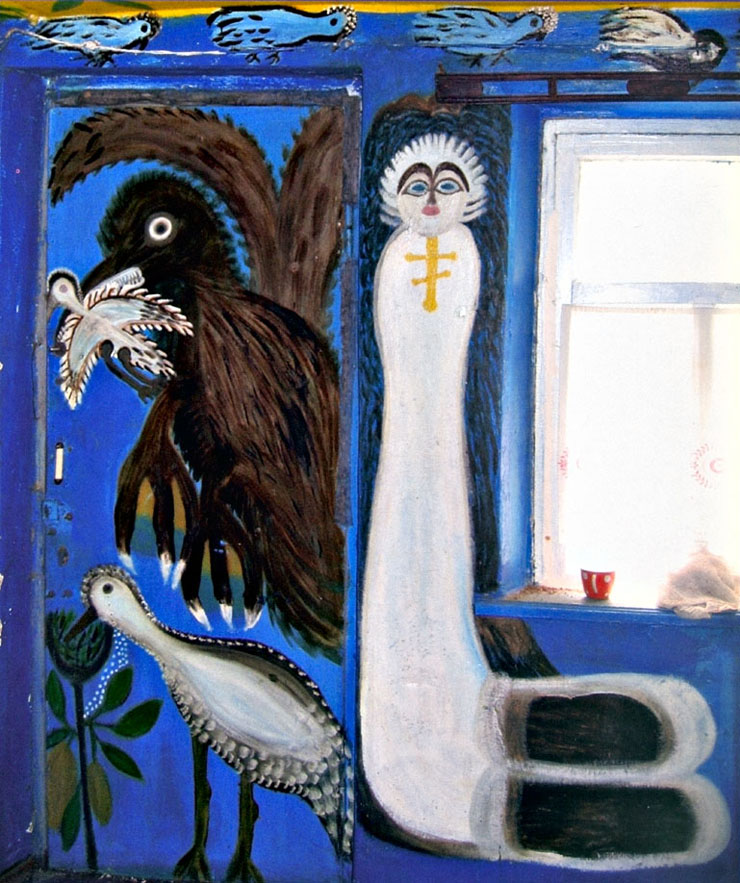
Flowers began to grow from the windowsills, mythological beasts roamed the edges of rooms, primordial forests grew beside kitchen cupboards. Babushka-Polina's strange enchanting figures, animals and scenes covered the walls throughout her house. Her colours are bright, and the paintings have overwhelming presence. As Nataliya Kosmolinska says, it is as if these things were born new from the Yaytse-Raytse (the Ukrainian Mythic Egg from which all things are born).

Above: imagery inspired by "Arktika" water bottle label.
All photos above by Oleksiy Kachmar

Polina used ordinary house paint, and for inspiration she took images from water bottles, chocolate, wine labels, religious postcards and translated them onto her house walls. In all she painted thirty-six walls, nine ceilings, and some of the courtyard.


All photos above and below from English Russia and Kolya-S-Raena

In the last years of her life, Polina's creations were discovered by tourists and there followed visits from journalists, artists, film directors and many others. Communist ideology creeps into her work in places: hammer and sickle, a female Soviet Army captain and a "military medic". But much of her imagery was religious in nature, with churches, saints, winged figures and heavenly birds appearing regularly. After Polina's death on January 15th 2004, a painted phrase was found on the garage door: "How to find a way to paradise..."

Nadia

The house was inherited by Polina's grandson who was utterly unappreciative of her work, and saw nothing in his grandmother's strange paintings. He put it up for sale for $6000 and it was bought by an American couple living in the Ukraine. It is inhabited now by Nadia, a relative of Polina's, who sees herself as a kind of museum curator. Sadly the paintings were made directly onto the plaster and so with the passing of time and damp, the paint is peeling away in places...


* * * * * * * * * * * * * *
What fascinates me about these women is the obsessiveness in their painting. Perhaps because they've kept a lid on their creativity all their lives, and it boils over dramatically in their later years, we see wild, imaginative, otherworldly art produced lavishly beyond the boundaries. There is a difference about it. But the interesting thing is that it is not "Art" but paintings, all over the walls of these women's houses. This transgresses any staid assumption of social boundary - i.e. what is or is not acceptable in one's dwelling place. It is too much. It is mad. And it is marvellous! They are peasant frescoes, and are utterly truly-wrought I think.

There seems to be a spiritual element to the work too, it is a kind of mantra, the repeated designs and complete covering of all surfaces appear like a constant and dedicated prayer. And the beauty of the work must not be forgotten either: to make your surroundings so colourful and decorative and replete with symbolic imagery is a magnificent and powerful thing. Entering these houses must feel quite wonderful.
For me there's a delicious juxtaposition between the sacred and the profane here: Polina Raïko longed to paint a church, but could not until she found an image on a wine bottle label for reference. And the eagerness and obsessiveness with which these women painted belies some seeming sacred purpose, written out on the edge-place of the ordinary.

I leave you with a quote from Jean Dubuffet who defined Art Brut thus:

"Those works created from solitude and from pure and authentic creative impulses – where the worries of competition, acclaim and social promotion do not interfere – are, because of these very facts, more precious than the productions of professionals. After a certain familiarity with these flourishings of an exalted feverishness, lived so fully and so intensely by their authors, we cannot avoid the feeling that in relation to these works, cultural art in its entirety appears to be the game of a futile society, a fallacious parade."

~ Jean Dubuffet. Place à l'incivisme (Make way for Incivism).
Art and Text
no.27 (December 1987 - February 1988). p.36


* * * * * * * * * * * * * *

If you are interested in seeing and reading more about Outsider Art, I can highly recommend Raw Vision Magazine.
And thanks for information and photo credits go to these sites:
Outsider Environments Europe
Animula Vagula
(both of the above also recommended for Outsider Art enthusiasts)
English Russia
Oleksiy Kachmar
Laatuaika
Kolya-S-Raena
Nataliya Kosmolinska
Totem, Kherson